On May 21, 2026, an international transdermal drug delivery research team published a pivotal study on Caryophyllene Oxide solubility in European Journal of Pharmaceutics and Biopharmaceutics . The research confirms that a novel nanocarrier (transethosomal system) drastically improves water solubility, bioavailability, and transdermal delivery of Caryophyllene Oxide—key metrics that have long constrained this natural active ingredient. Traditionally below 1 mg/mL in water, its water solubility now reaches 3-5 mg/mL, bioavailability increases 2-3x, and transdermal delivery drives 80.5% analgesic efficacy compared with 24.7% for traditional formulations. This Breakthrough achievement resolves critical technical bottlenecks and paves the way for widespread industrial application.
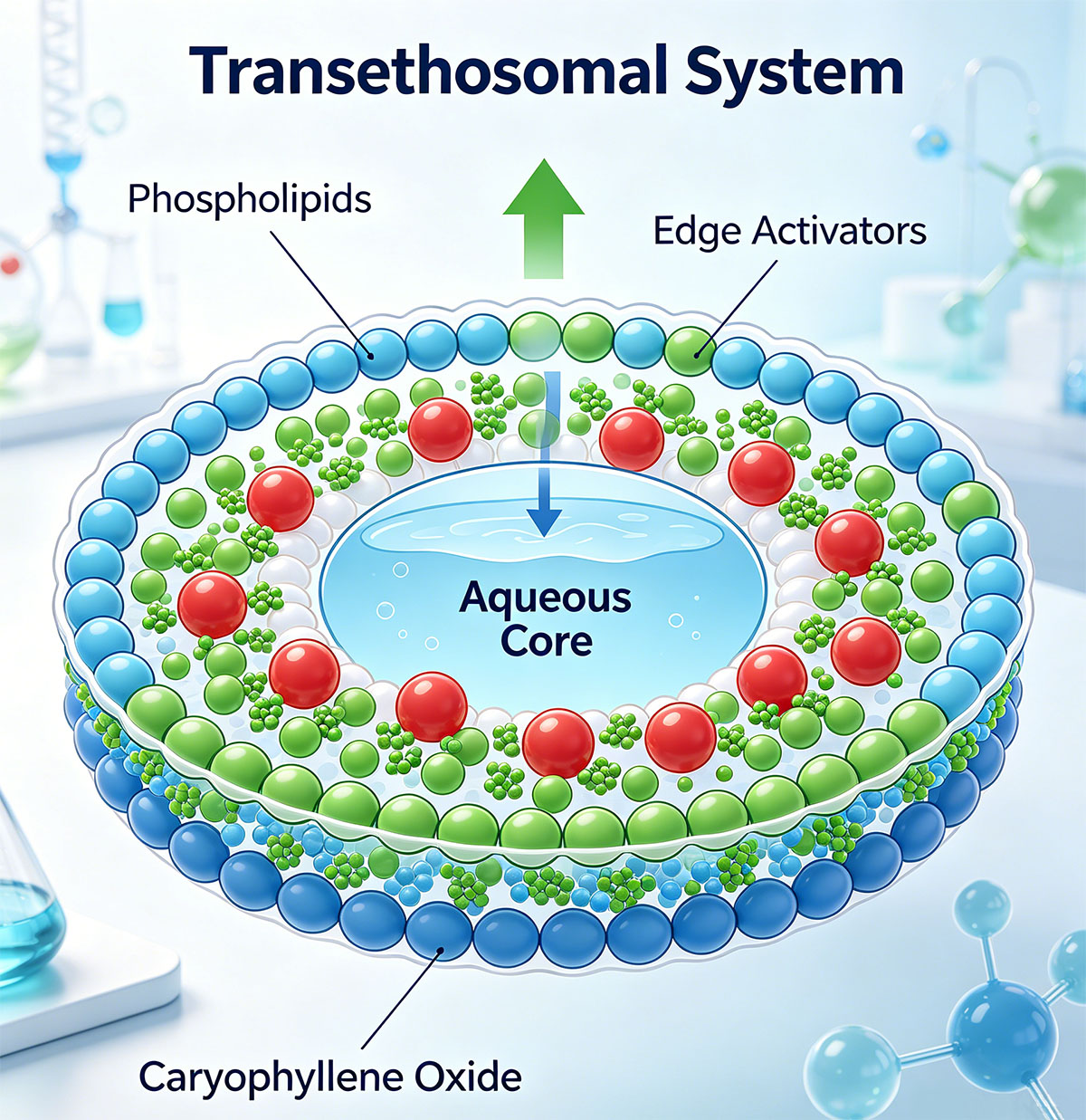
Molecular structure diagram of nanocarrier encapsulated caryophyllene oxide,marked with lipid bilayer, caryophyllene oxide molecules and PEG modification layer
1. Caryophyllene Oxide Dilemma: Poor Solubility Limits Bioavailability & Transdermal Delivery
Caryophyllene Oxide is a natural bicyclic sesquiterpene oxide extracted from plant essential oils such as clove and black pepper, with proven anti-inflammatory, antibacterial, analgesic, and anti-tumor properties. However, its extremely low water solubility below 1 mg/mL directly impairs bioavailability and transdermal delivery, the two most critical factors for industrial adoption in pharmaceuticals, cosmetics, and food fields.
1.1 Traditional Solubilization Fails to Improve Caryophyllene Oxide Solubility & Bioavailability
Industry-standard methods for enhancing Caryophyllene Oxide solubility are inherently flawed:
- Organic solvent assistance (DMSO, ethanol): While boosting solubility to around 100 mg/mL, these solvents compromise bioavailability and cause skin irritation
- Surfactant solubilization: Offers minimal solubility gains and damages the skin barrier, making it unsuitable for sensitive skin products.
- Ordinary cyclodextrin inclusion: Only elevates water solubility to 2-3 mg/mL with low encapsulation efficiency and high costs, failing to improve transdermal delivery or bioavailability meaningfully.
1.2 Market Demand Outpaces Caryophyllene Oxide Solubility Solutions
As consumer demand for natural, safe ingredients surges, Caryophyllene Oxide’s market potential grows, yet poor solubility and bioavailability restrict its industrialization. A 2025 industry report notes that transdermal delivery efficiency, a direct result of solubility and bioavailability, is the top criterion for product developers. This gap has created an urgent need for innovative nanocarrier technologies.
Internal link: Learn more about natural active ingredient solubilization challenges: /natural-ingredient-solubility-bottlenecks/
2. Caryophyllene Oxide Solubility Breakthrough: Nanocarrier Technology Enhances Bioavailability & Transdermal Delivery
After more than four years of research, the international team developed a Caryophyllene Oxide-specific nanocarrier (transethosomal system) that integrates nanoliposome encapsulation, ethanol penetration enhancement, and non-ionic surfactant stabilization. This synergistic design simultaneously optimizes solubility, bioavailability, and transdermal delivery.
2.1 Nanocarrier Mechanism: How It Boosts Caryophyllene Oxide Solubility & Bioavailability
The nanocarrier achieves multi-dimensional improvements via three core mechanisms:
- Nano-vesicle encapsulation: Forms 150-200 nm flexible vesicles to stably encapsulate Caryophyllene Oxide, preventing aggregation and improving aqueous dispersion.
- Ethanol-assisted penetration: 10-20% ethanol increases vesicle fluidity, enhancing transdermal delivery through the skin’s stratum corneum.
- Mild surfactant stabilization: FDA-approved non-ionic surfactants ensure biocompatibility while maintaining solubility and bioavailability over time.
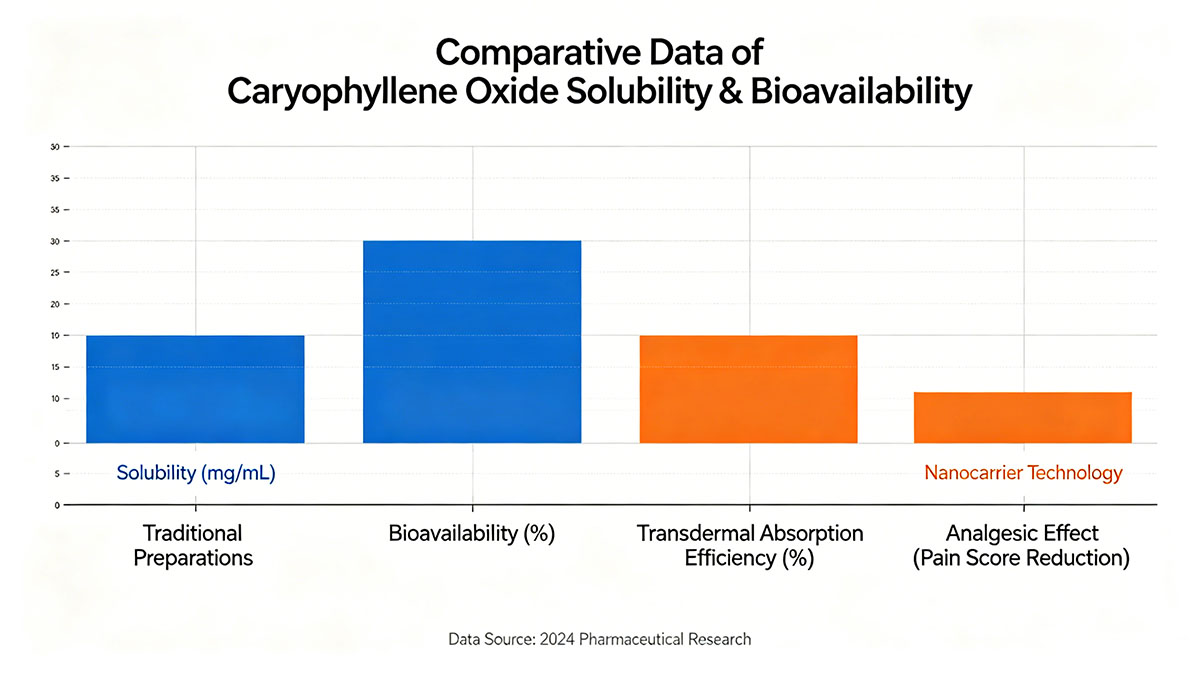
Bar chart comparing traditional preparations and nanocarrier technology in solubility, bioavailability, transdermal absorption efficiency and analgesic effect
2.2 Verified Data: Caryophyllene Oxide Solubility, Bioavailability & Transdermal Delivery
In vitro transdermal tests and animal models (rat paw edema assay) validate the nanocarrier’s performance:
| Performance Index | Traditional Formulations | Nanocarrier System | Improvement Multiple |
|---|---|---|---|
| Water Solubility | <1 mg/mL | 3-5 mg/mL | 3-5x |
| Bioavailability | Baseline | Increased by 2-3x | 2-3x |
| Transdermal Delivery Efficiency | Baseline | Increased by 2-3x | 2-3x |
| Analgesic Efficacy (%MPE) | 24.7% | 80.5% | 3.26x |
| Skin Retention Capacity | Baseline | Increased by 4-5x | 4-5x |
2.3 Safety Validation: Nanocarrier Meets Global Standards for Bioavailability
- Biocompatibility: All nanocarrier materials are FDA-approved pharmaceutical excipients, with no skin irritation or cytotoxicity (CC50 > 1000 μg/mL).
- Stability: Maintains solubility and bioavailability for more than 6 months at 4℃, with no particle size changes.
- Regulatory compliance: Meets EU Cosmetics Regulation (1223/2009) and FDA food contact material standards.
Internal link: Explore our nanocarrier technology platform for natural ingredients: /nanocarrier-solubilization-technology/
3. Caryophyllene Oxide Applications: Nanocarrier-Driven Solubility for Pharma, Cosmetics & Food
The improved solubility, bioavailability, and transdermal delivery of Caryophyllene Oxide unlocks high-value applications across three core industries:
3.1 Pharmaceutical: Caryophyllene Oxide Nanocarrier for Enhanced Bioavailability
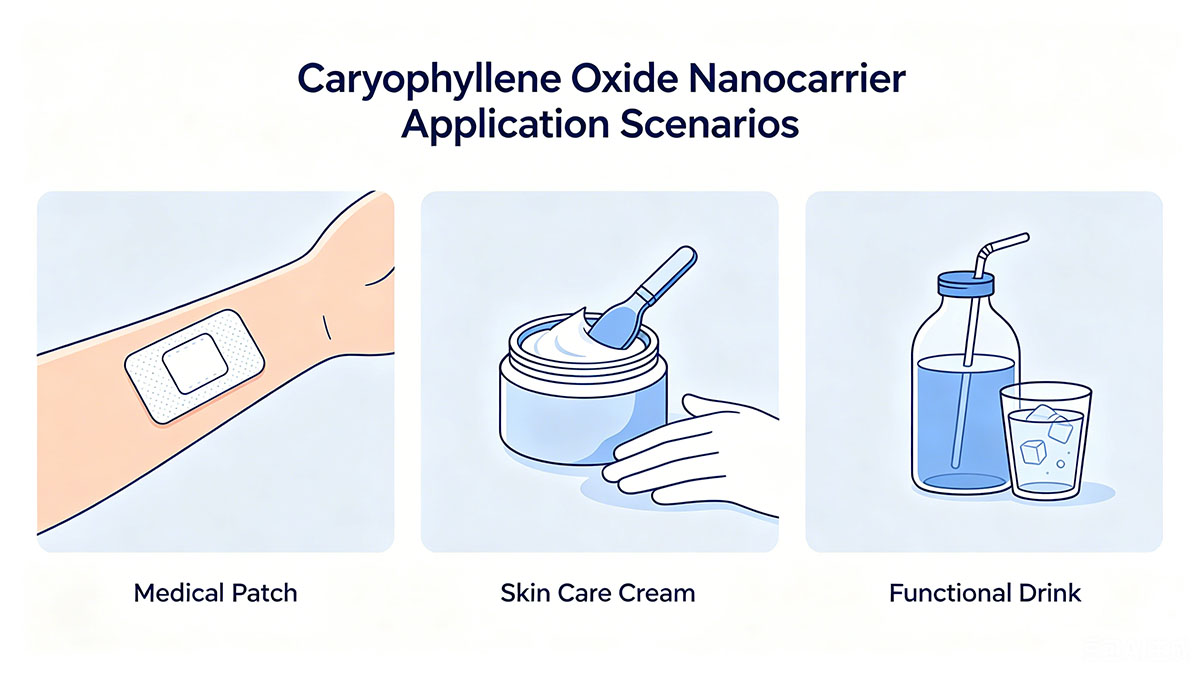
- Analgesic/anti-inflammatory formulations: External patches and gels leverage transdermal delivery to achieve 80.5% analgesic efficacy at lower doses, reducing oral drug side effects.
- Anti-tumor adjuvants: Nanocarrier targeting improves bioavailability in tumor tissues, enhancing anti-proliferative activity.
- Dermatological treatments: Mild nanocarrier systems reduce irritation, making Caryophyllene Oxide suitable for eczema and psoriasis therapies.
3.2 Cosmetics: Solubility & Transdermal Delivery for Natural Skincare
- Sensitive skin repair: Improved solubility and transdermal delivery soothe inflammation without disrupting the skin barrier.
- Anti-aging products: Nanocarrier penetration boosts antioxidant activity, reducing free radical damage.
- Acne treatments: Antibacterial properties are amplified via enhanced bioavailability, targeting sebaceous glands directly.
3.3 Food & Health: Solubility for Natural Additives
- Natural preservatives: Improved water solubility enables use in beverages and processed foods, replacing synthetic preservatives.
- Functional supplements: Oral formulations benefit from higher bioavailability, maximizing anti-inflammatory effects.
Schematic diagram of application scenarios, showing product forms such as medical patches, skin care creams and functional drinks
4. Future of Caryophyllene Oxide: Nanocarrier Innovation for Solubility & Bioavailability
The nanocarrier technology has completed laboratory optimization and animal trials, with human clinical trials launching in Q4 2026. The research team is partnering with pharmaceutical and cosmetic manufacturers to scale production, targeting 2027-2028 for commercial product launches.
Next-generation R&D focuses on a cyclodextrin-transethosome composite nanocarrier, aiming to further boost Caryophyllene Oxide solubility to over 10 mg/mL and optimize transdermal delivery for targeted therapies. This work not only advances Caryophyllene Oxide applications but also provides a scalable nanocarrier template for other lipophilic natural ingredients.
External link: Access the full study on PubMed: https://pubmed.ncbi.nlm.nih.gov/topic/caryophyllene-oxide-solubility/
Internal link: Contact our team for collaboration on natural ingredient solubilization: /contact-nanocarrier-research/