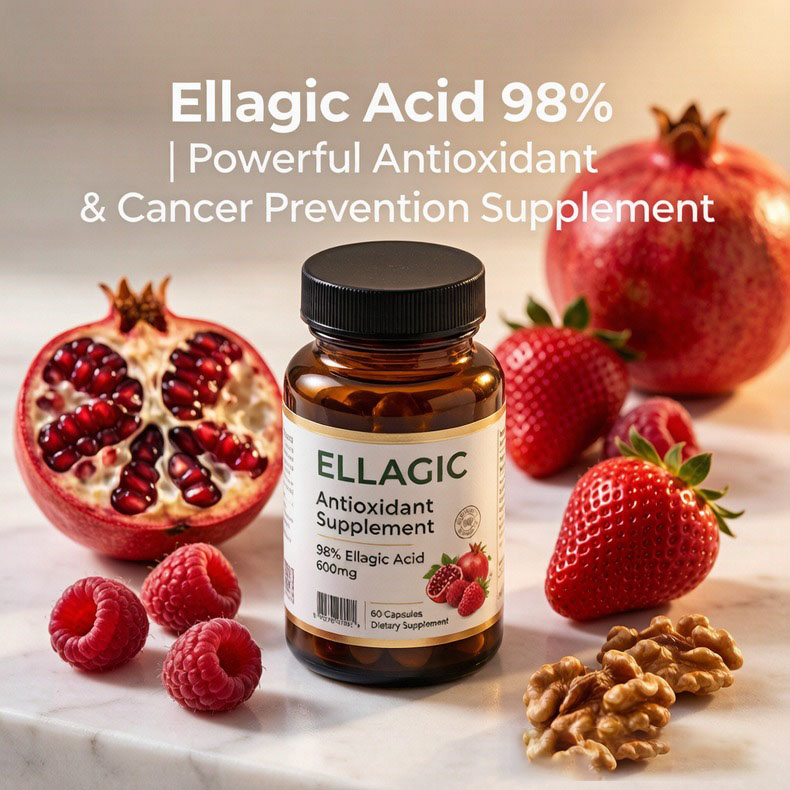
Ellagic Acid 98% Powerful Antioxidant & Cancer Prevention Supplement
Product Introduction
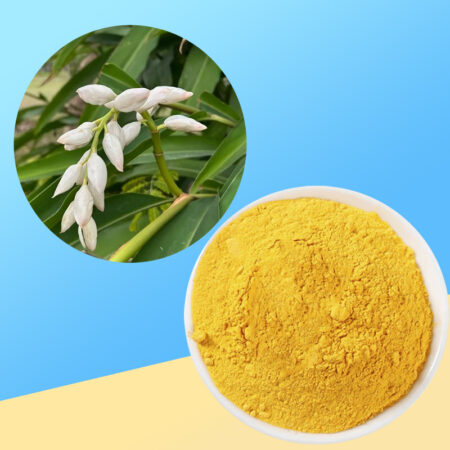
Ellagic acid (CAS 476-66-4) is a naturally occurring polyphenolic compound classified as a dilactone of hexahydroxydiphenic acid (HHDP). Found abundantly in pomegranates, raspberries, strawberries, blackberries, walnuts, pecans, and oak galls, ellagic acid is one of the most extensively researched phytochemicals for its remarkable spectrum of biological activities: potent antioxidant, anti-inflammatory, anti-carcinogenic, antimicrobial, and skin-brightening properties. It occurs naturally in plant tissues as free ellagic acid or in a bound form as hydrolyzable ellagitannins (punicalagin, punicalin, castalagin, etc.), which are enzymatically or acid-hydrolyzed to release free ellagic acid during processing and digestion.
Chemical Identification
| Parameter | Detail |
| Product Name (IUPAC) | 2,3,7,8-Tetrahydroxy[1]benzopyrano[5,4,3-cde][1]benzopyran-5,10-dione |
| Common Name | Ellagic Acid |
| CAS Registry Number | 476-66-4 |
| Molecular Formula | C14H6O8 |
| Molecular Weight | 302.19 g/mol |
| EC / EINECS Number | 207-508-3 |
| Chemical Class | Polyphenol — Dilactone of hexahydroxydiphenic acid (HHDP) |
| Structural Feature | Four phenolic hydroxyl groups + two lactone rings (fused polycyclic) |
| InChI Key | AFSDNFLWKVMVRB-UHFFFAOYSA-N |
| SMILES | Oc1cc2c(=O)oc3cc(O)c(O)cc3c3c(=O)oc4cc(O)c(O)cc4c1=3 |
| PubChem CID | 5281855 |
| HS Code | 2914.79 (Ketones; phenolic; other) |
| Natural Sources (Primary) | Pomegranate peel (Punica granatum), Oak gall (Galla Chinensis), Walnut hull (Juglans regia) |
| Natural Sources (Secondary) | Raspberries, strawberries, blackberries, pecans, longan seed |
| Pharmacopoeia Status | Listed in various national and international pharmacopoeias as reference standard |
| GRAS Status | Generally regarded as safe when derived from food-grade botanical sources |
Applications
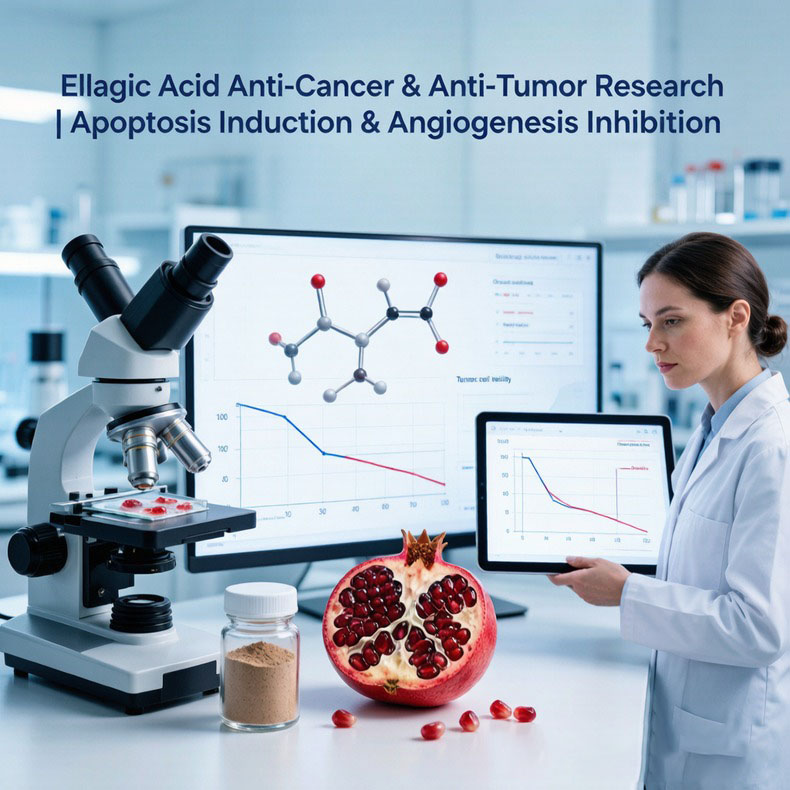
Dietary Supplements & Nutraceuticals
The largest and fastest-growing application for Ellagic Acid. Common supplement formats include:
- Pomegranate Peel Extract capsules (40%–70% EA, 500–1,000 mg/serving)
- High-purity Ellagic Acid softgels (90%–98%, 100–500 mg/serving)
- Antioxidant complexes (combining EA with vitamin C, resveratrol, quercetin)
- Cancer prevention formulas (EA + curcumin + green tea EGCG + sulforaphane)
- Heart health supplements (pomegranate extract standardized to 40% punicalagins + EA)
- Gut health / microbiome support products (EA → Urolithin A precursor)
- Women’s health formulas (anti-aging, hormonal balance, PCOS support)
Cosmetics & Personal Care
Ellagic acid is a gold-standard skin brightening ingredient, extensively used in Asian cosmetic markets (Japan, South Korea, China) and rapidly expanding globally. Applications include:
- Skin brightening serums and essences (0.2–1.0% EA, often combined with niacinamide, vitamin C, kojic acid)
- Anti-melasma creams and spot treatment products
- Anti-aging moisturizers (MMP-1 inhibition, collagen protection)
- UV damage repair and photoprotective formulations
- Anti-inflammatory skincare for acne, rosacea, and sensitive skin
- Hair care for scalp health and UV-induced hair damage protection
Formulation note: Low water solubility requires encapsulation (liposomal, microemulsion) or use of propylene glycol/butylene glycol as solubilizers for effective cosmetic delivery. Water-dispersible grades with amphiphilic excipients offer improved ease of formulation.
FAQ
Q1: What is the best natural source of Ellagic Acid?
Pomegranate peel (Punica granatum) is the most commercially important source, containing 15–25% ellagic acid equivalents as ellagitannins (punicalagin, punicalin). Oak gall (Galla Chinensis, gallotannins hydrolysis product) provides higher-purity free ellagic acid after hydrolysis, making it the preferred source for 90–98% pharmaceutical-grade extract. Other notable sources include raspberries, strawberries, walnuts, and pecans, though these are not commercially viable for extract production.
Q2: What is the recommended dosage for dietary supplements?
Typical dietary supplement dosages: 100–500 mg/day of high-purity (≥90%) Ellagic Acid, or 500–1,500 mg/day of 40–50% pomegranate peel extract. For cancer prevention or intensive antioxidant support, some formulas use 500–1,000 mg of 98% EA daily. Cosmetic topical application: 0.2–1.0% Ellagic Acid in cream, serum, or essence formulations. Always consult a healthcare professional for therapeutic applications.
Q3: How does Ellagic Acid differ from Urolithin A?
Ellagic Acid is the plant-derived parent compound (polyphenol dilactone) with direct antioxidant and anti-cancer activities. Urolithin A (UA) is the gut microbial metabolite produced from ellagic acid by Gordonibacter and Ellagibacter species. UA has superior bioavailability and systemic distribution, activating mitophagy (mitochondrial quality control) and demonstrating significant longevity and muscle health benefits. Approximately 40% of people are classified as non-producers of Urolithin A due to microbiome composition, making direct Urolithin A supplementation or high-dose EA supplementation relevant strategies for non-converter populations.
Q4: Why is Ellagic Acid poorly soluble, and how is this addressed?
Ellagic acid’s low water solubility (log P 1.52; planar rigid ring system with strong intermolecular H-bonding) is a significant formulation challenge. Solutions include: (1) Liposomal encapsulation — improves oral bioavailability 5–10×; (2) Phospholipid complexation (phytosome technology); (3) Nanoparticle formulations (PLGA, chitosan); (4) Solid dispersion with PVP/HPMC — improved dissolution in GI; (5) Use of propylene glycol or butylene glycol as cosolvents for cosmetic formulations; (6) Our water-dispersible microencapsulated grade (40%) using food-grade hydrophilic excipients for beverage applications.
Q5: Which grade should I choose for skin brightening cosmetics?
For standard cosmetic brightening formulations (serums, creams): 90–95% high-purity grade offers excellent purity at a commercially viable cost, with consistent light yellow color compatible with cosmetic aesthetics. For premium “clinical-grade” cosmetics or medical aesthetics products: 98% pharmaceutical grade ensures maximum purity and minimal batch-to-batch color variation. Recommended use level: 0.2–0.5% (stable in formulations at pH 4–6 with antioxidant support such as vitamin C or ferulic acid).
Q6: Is Ellagic Acid safe for pregnancy and children?
Food sources of ellagic acid (pomegranate juice, berries) are generally considered safe during pregnancy. High-dose supplementation (concentrated extracts, 100 mg+ daily) is not recommended during pregnancy or lactation due to insufficient clinical safety data. For children, dietary food sources are acceptable; concentrated supplements should be avoided in children under 12 without medical supervision. Topical cosmetic use at standard concentrations (0.2–1%) is generally considered safe for all age groups.