Vitamin E Oil CAS 59-02-9 | Natural Antioxidant for Skincare, Supplements & Food

Product Introduction
Vitamin E Oil (CAS 59-02-9) refers to oil-based preparations containing alpha-Tocopherol (α-Tocopherol), the most biologically active form of Vitamin E and one of the most powerful fat-soluble antioxidants in nature. Alpha-Tocopherol is a member of the tocopherol family — a group of four tocol compounds (α, β, γ, δ) that together constitute Vitamin E activity. Our Vitamin E Oil is derived from natural vegetable sources (primarily soybean oil distillate and sunflower oil) through molecular distillation and subsequent purification, offering superior bioavailability compared to synthetic dl-alpha-tocopherol.
As a fat-soluble antioxidant, Vitamin E Oil protects cell membranes, lipids, and other biological structures from oxidative damage caused by free radicals and reactive oxygen species (ROS). It is an indispensable ingredient across skincare and cosmetics, dietary supplements, functional foods, and pharmaceutical formulations. Our natural Vitamin E Oil (d-alpha-tocopherol) is available in a range of concentrations from food-grade mixed tocopherols to pharmaceutical-grade 96%+ alpha-tocopherol, and in both oil and acetate ester forms.
Product Identification
| Parameter | Value |
| Common Name | Vitamin E Oil; alpha-Tocopherol Oil |
| IUPAC Name | (2R)-2,5,7,8-Tetramethyl-2-[(4R,8R)-4,8,12-trimethyltridecyl]-3,4-dihydro-2H-chromen-6-ol |
| CAS Number | 59-02-9 (d-alpha-Tocopherol, natural) |
| Also Referenced | CAS 10191-41-0 (dl-alpha-Tocopherol, synthetic); CAS 7695-91-2 (Tocopherol acetate) |
| Molecular Formula | C₂₉H₅₀O₂ |
| Molecular Weight | 430.71 g/mol |
| EU Food Additive Code | E306 (mixed tocopherol concentrate); E307 (alpha-tocopherol); E308 (gamma); E309 (delta) |
| INS Number | 307 (alpha-Tocopherol) |
| EC Number | 200-412-2 |
| MDL Number | MFCD00004389 |
| Source | Natural vegetable oils — soybean, sunflower (non-GMO available) |
| Appearance | Clear, pale yellow to amber viscous oil |
| Odor | Characteristic mild, slightly fatty odor |
| Solubility | Insoluble in water; freely soluble in ethanol, acetone, ether, chloroform, vegetable oils |
| Shelf Life | 24 months under recommended storage conditions |
Applications
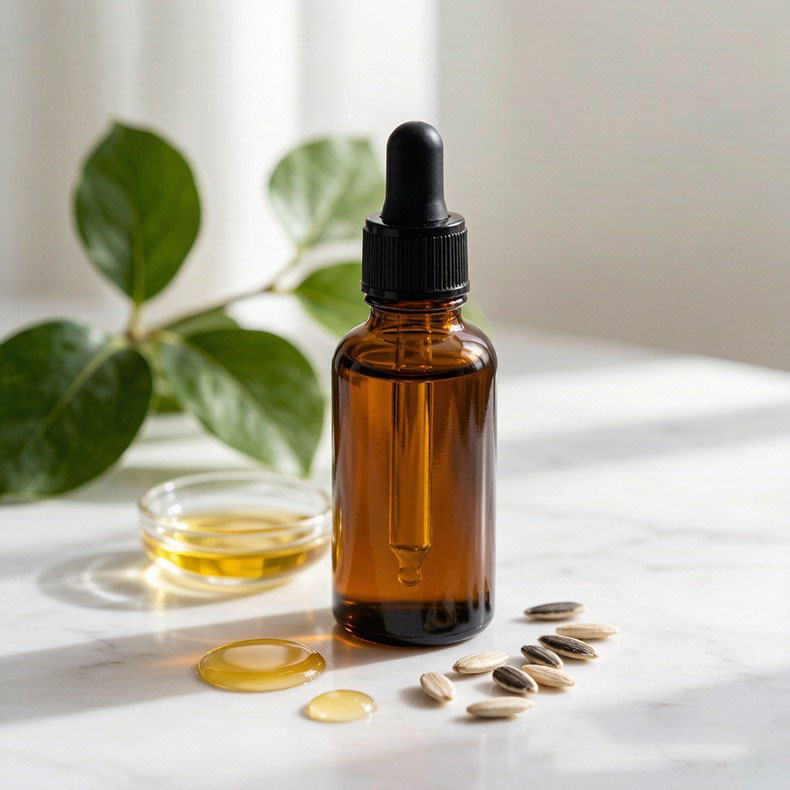
Skincare & Cosmetics
- Face serums and facial oils — topical antioxidant for anti-aging
- Eye creams and under-eye treatments — reduces oxidative skin damage
- Moisturizers and emollients — enhances skin barrier function and hydration
- Sunscreens and UV protection products — photoprotective synergist with sunscreen actives
Dietary Supplements
- Vitamin E softgel capsules — antioxidant and immune health
- Multivitamin and mineral complexes — fat-soluble vitamin component
- Cardiovascular health supplements — LDL oxidation protection
- Women’s health supplements — fertility and pregnancy support
FAQ
Q1: What is the difference between natural (d-alpha-tocopherol) and synthetic (dl-alpha-tocopherol) Vitamin E oil?
Natural d-alpha-tocopherol (CAS 59-02-9) consists of a single RRR-stereoisomer that is selectively recognized and retained by the body’s alpha-tocopherol transfer protein (α-TTP). Synthetic dl-alpha-tocopherol (CAS 10191-41-0) is a racemic mixture of 8 stereoisomers, of which only 1/8 (12.5%) is the RRR form. As a result, natural Vitamin E has approximately 1.49 IU/mg biological activity versus approximately 1.10 IU/mg for synthetic, and studies consistently show natural Vitamin E is retained 2× more effectively in human plasma and tissues. We recommend natural d-alpha-tocopherol for premium supplement and cosmetic applications.
Q2: What concentration grades of Vitamin E Oil do you offer?
We offer multiple concentration grades to suit different applications: (1) Natural Mixed Tocopherols Concentrate — typically 60–90% total tocopherols, used as food antioxidant (E306); (2) d-alpha-Tocopherol 70% Oil — blended in vegetable carrier oil; (3) d-alpha-Tocopherol 96%+ Oil — pharmaceutical and premium supplement grade; (4) Tocopherol Acetate (Vitamin E Acetate) — oxidatively stable ester form for cosmetics and supplements with extended shelf life. Custom concentrations and oil blends are available upon request.
Q3: What is the recommended daily intake of Vitamin E?
The recommended dietary allowance (RDA) for Vitamin E varies by age and regulatory authority. The US NIH recommends 15 mg (22.4 IU) d-alpha-tocopherol per day for adults. The EU NRV is 12 mg/day. Tolerable Upper Intake Level (UL) is 1,000 mg/day for adults. For dietary supplement use, common doses are 200–400 IU/day. Clinical applications may use higher doses under medical supervision. We recommend consulting with a healthcare professional for specific dosage guidance.
Q4: Can Vitamin E Oil be used directly on the skin?
Yes. Vitamin E Oil (d-alpha-tocopherol or tocopherol acetate) is one of the most widely used topical skincare ingredients. It can be applied neat (undiluted) in small amounts to specific areas (scars, dry skin, cuticles), or formulated into creams, serums, and facial oils at typical concentrations of 0.1–5%. For sensitive skin, dilution in a carrier oil (jojoba, rosehip, argan) at 1–2% is recommended. Tocopherol acetate is preferred in some formulations due to its superior oxidative stability.
Q5: Does your Vitamin E Oil contain allergens?
Our Vitamin E Oil is derived from soybean oil distillate or sunflower oil during production. Soy is a major food allergen in some regulatory frameworks (EU, US). While the final highly purified alpha-tocopherol product contains no detectable soy protein (the allergenic component), we provide a full allergen statement with each batch. Sunflower-derived Vitamin E Oil is available for customers requiring a soy-free supply chain. Please specify your allergen requirements when ordering.
Q6: What is Vitamin E Acetate (Tocopheryl Acetate) and how does it differ from Vitamin E Oil?
Tocopheryl Acetate (CAS 7695-91-2) is the acetic acid ester of alpha-tocopherol. It is significantly more stable to oxidation than free tocopherol, making it the preferred form for cosmetics, skin care, and some dietary supplements. In supplements, it is cleaved by intestinal esterases to release free alpha-tocopherol for absorption. Topically, skin esterases also convert it to active tocopherol, though the conversion rate varies. We offer both free d-alpha-tocopherol oil and tocopheryl acetate oil forms.