Natural caryophyllene oxide reshapes the rules of multiple industries.
—— A Natural Compound with Bioactivity and Industrial Value Leads the Upgrade of Fragrance, Pharmaceutical, and Cosmetic Industries
(Special Report by [Correspondent’s Name]) Recently, with the implementation of multiple research achievements and the expansion of industrial applications of caryophyllene oxide (CAS No.: 1139-30-6), this bicyclic sesquiterpene compound derived from essential oils of clove, black pepper, and other plants has set off an innovation boom in the fragrance, pharmaceutical, skincare, and daily chemical industries due to its unique chemical properties and diverse bioactivities. From the research on giant pandas’ low-temperature adaptation mechanism to the technological breakthrough of transdermal absorption enhancers, its industrial value continues to be released, making it a key raw material for the green upgrading of related industries.
I. Natural Properties and Core Characteristics Lay the Industrial Foundation
Caryophyllene oxide has the molecular formula C15H24O, presenting as a white crystalline powder with a woody-spicy aroma and a melting point of 62-63°C. It complies with the EU Cosmetics Regulation (1223/2009), IFRA standards, and China’s GB2760 Food Additive List. As a low-toxic flammable solid (oral LD50 in rats > 5000 mg/kg), it requires storage at 2-8°C in a dark and moisture-proof environment, making it an ideal alternative to some chemically synthesized raw materials. Global industrial sales have maintained steady growth from 2021 to 2025, with rising demand for high-purity products (≥98%) and supply dominated by leading enterprises.
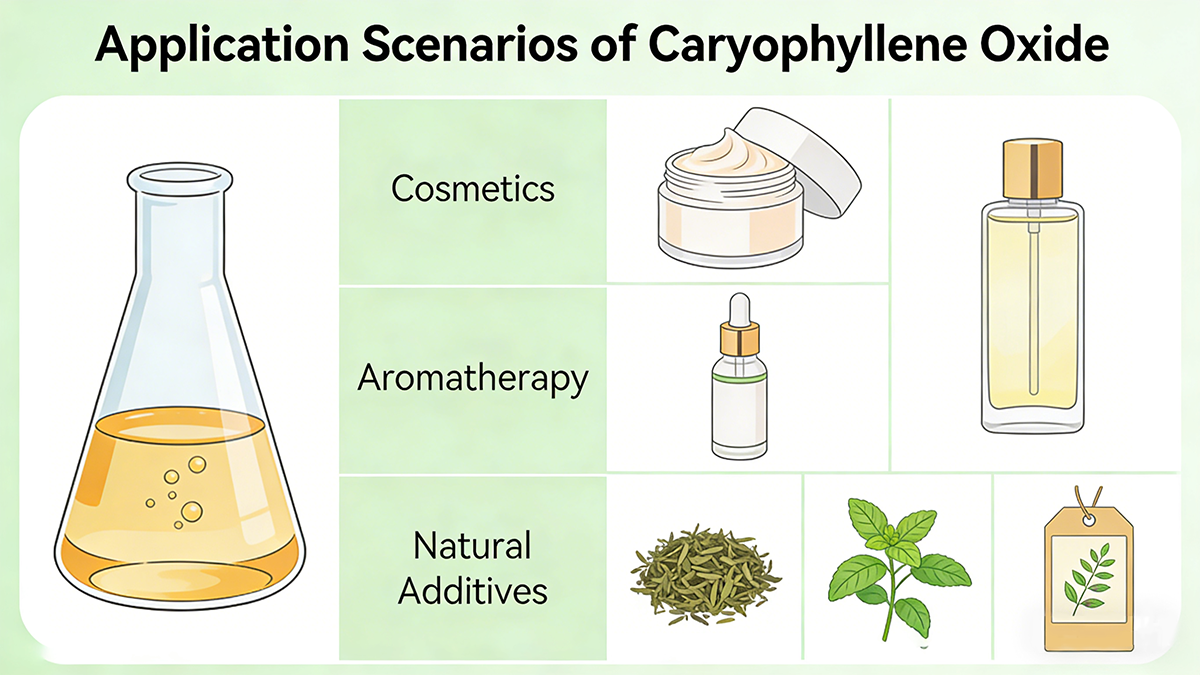 Achieving breakthrough applications across five major industries: food, daily chemicals, pharmaceuticals, agriculture, and advanced materials.
II. Breakthroughs in Bioactivity Research, Prominent Cross-Border Potential
- Temperature Perception Regulation: A 2024 study found that caryophyllene oxide can bind to the TRPM8 cold receptor on giant pandas’ skin, blocking Ca²⁺ channels to reduce low-temperature perception and increasing the cold tolerance threshold by 5-8°C. The frequency of giant pandas’ contact with areas sprayed with 0.3% concentration solution increased by 3.2 times compared to the control group, providing new ideas for the protection of animals in extreme environments.
- Antibacterial and Pharmacological Applications: At a concentration of ≥0.8 mg/mL, it inhibits Klebsiella pneumoniae by 78.3%, with its epoxidized structure damaging bacterial cell membrane permeability. When combined with acetaminophen, it enhances analgesic effect by 32% while reducing the risk of gastric mucosal injury, involving the regulation of the TRPV1 receptor pathway. In addition, its derivatives show significant inhibitory activity against parasites such as Leishmania donovani and Trypanosoma brucei, offering new directions for antiparasitic drug development.
- Transdermal Absorption Enhancement: A national patent published in late 2025 revealed that caryophyllene oxide is first applied to promote the transdermal absorption of macromolecular polar substances (e.g., polysaccharides, polypeptides). Its penetration-enhancing effect is superior to traditional terpenoid enhancers (1,8-cineole, β-caryophyllene), with significantly lower skin irritation than the chemically synthesized enhancer azone. This technology can increase the skin permeability of active ingredients such as ganoderma polysaccharides and hirudin by more than 30%, suitable for various external preparations and cosmetics with an addition concentration of only 0.5%-5%.
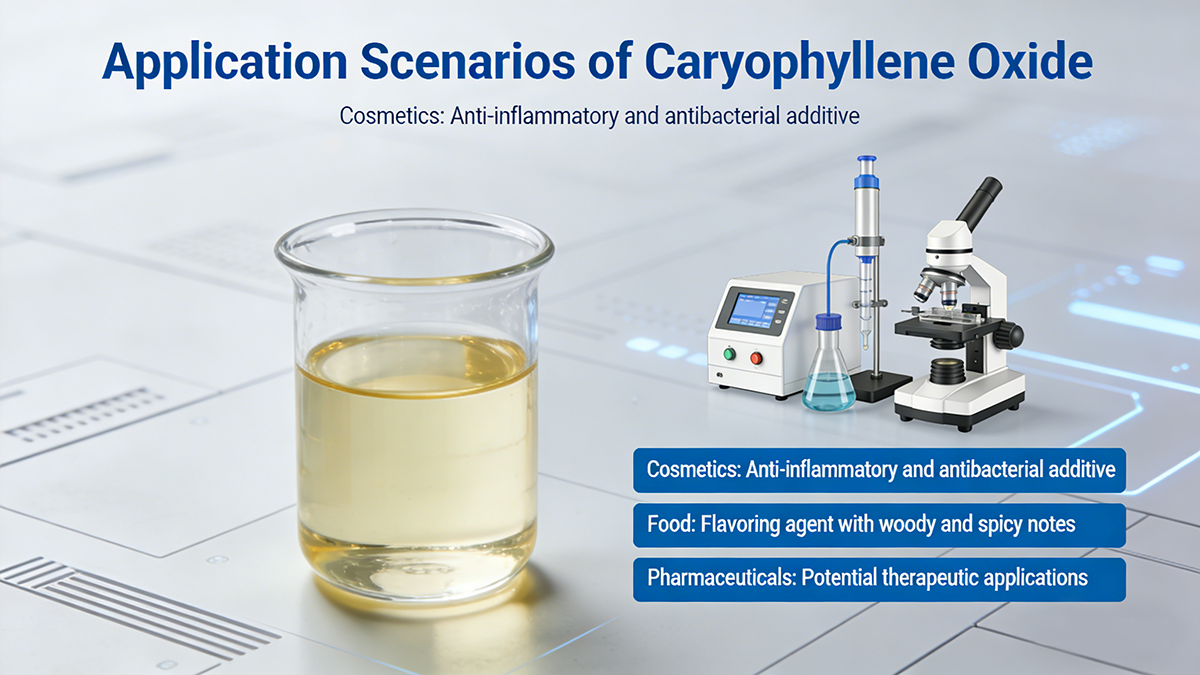
Natural Active Caryophyllene Oxide: Breakthrough Applications in Multiple Fields and Future Value
III. Large-Scale Multifield Applications, Broad Market Prospects
- Fragrance, Food, and Daily Chemicals: As a compliant fragrance raw material (FEMA No. 4085), its woody-spicy note provides a unique flavor for perfumes, shampoos, aromatherapy products, and can be used in formulating citrus and herbal flavors for food and beverages, with long-lasting and stable aroma.
- Pharmaceuticals and Pesticides: Relying on antibacterial, anti-inflammatory, and analgesic activities, it serves as a core pharmaceutical intermediate for the development of external anti-inflammatory ointments and analgesic preparations. Its natural insect-repellent activity enables it to emerge in the green pesticide field, realizing residue-free protection.
- Skincare: Combining anti-inflammatory soothing and transdermal penetration-enhancing effects, it is suitable for various skin types and has been incorporated into anti-aging and repairing cosmetic formulas, receiving positive market feedback.
From Plant Extract to Industrial Core: The Journey of Caryophyllene Oxide’s Cross-Industry Breakthroughs
IV. Industry Development Outlook
The global market size of caryophyllene oxide is expected to grow at an annual rate of over 8% from 2026 to 2032. Industry experts suggest optimizing extraction and synthesis processes to reduce costs and strengthening derivative research to expand application scenarios in anti-tumor, neuroprotection, and other fields. Currently, relevant enterprises have launched capacity expansion projects for high-purity caryophyllene oxide, and the global production capacity is expected to reach 500 tons/year by 2027 to meet the growing market demand.
The innovative application of caryophyllene oxide highlights the industrial potential of natural plant compounds and provides a new path for the green transformation of multiple industries. In the future, with the deepening of industry-university-research cooperation, this “natural multifunctional raw material” will continue to empower more segmented fields, bringing safer and more efficient product experiences to consumers.