Product Introduction
Vegetable Carbon Black (CAS No. 1333-86-4), also known as Vegetable Carbon, Carbon Black, Carbo Medicinalis Vegetabilis, E153 in the European Union, and CI 77266 in cosmetic ingredient nomenclature, is a high-purity natural black pigment produced through the controlled carbonization of plant-based raw materials such as wood, coconut shells, bamboo, and cellulose fibers. This finely divided, odorless, and tasteless black powder is widely recognized as one of the safest and most versatile natural black colorants available on the global market.
Unlike synthetic carbon black derived from petroleum, Vegetable Carbon Black is manufactured exclusively from renewable vegetable sources, making it an ideal choice for clean-label, natural, and organic product formulations. It is approved for use as a food additive in the European Union (E153), Japan, and many other countries, and is listed by the FDA as exempt from certification when used as a color additive in specific applications.
At Xi’an Taima Biological Co., Ltd. , we produce premium-grade Vegetable Carbon Black with exceptional purity, consistent particle size distribution, and superior coloring strength. Our product is certified ISO 9001, ISO 14001, KOSHER, and HALAL, ensuring the highest quality standards for global distribution.
Product Identification
| Product Name | Vegetable Carbon Black |
| Synonym | Vegetable Carbon, Carbo Medicinalis Vegetabilis, Activated Charcoal (Food Grade), Carbon Black (Vegetable Source) |
| CAS Number | 1333-86-4 |
| E Number (EU Food Additive) | E153 |
| CI Number (Cosmetic Ingredient) | CI 77266 |
| EC Number | 215-609-9 |
| INS Number | 153 |
| Molecular Formula | C (elemental carbon) |
| Appearance | Fine black powder, odorless, tasteless |
| Source | Carbonization of vegetable materials (wood, coconut shells, bamboo, cellulose) |
| Grade Available | Food Grade, Cosmetic Grade, Pharmaceutical Grade, Industrial Grade |
Applications
Food & Beverage Industry
Vegetable Carbon Black (E153) is widely used as a natural black food colorant across diverse food and beverage categories. Its excellent tinctorial power, thermal stability, and light stability make it the preferred choice for achieving deep, rich black hues without synthetic dyes.
- Ice Cream & Frozen Desserts: Black coconut ash ice cream, charcoal gelato, black soft serve
- Bakery & Confectionery: Black burger buns, charcoal bread, black macarons, black cake layers, black cookies
- Beverages: Black lemonade, charcoal detox drinks, black smoothies, black cocktails and mocktails
- Pasta & Noodles: Squid-ink style black pasta, black ramen noodles, black dumpling wrappers
- Dairy Products: Black yogurt, black cheese (specialty), charcoal-flavored milk drinks
- Confectionery: Black lollipops, black gummy candies, black chocolate coatings, black marshmallows
- Sauces & Seasonings: Black barbecue sauce, black aioli, black burger sauce
- Snack Foods: Black tortilla chips, charcoal crackers, black popcorn seasoning
Cosmetics & Personal Care
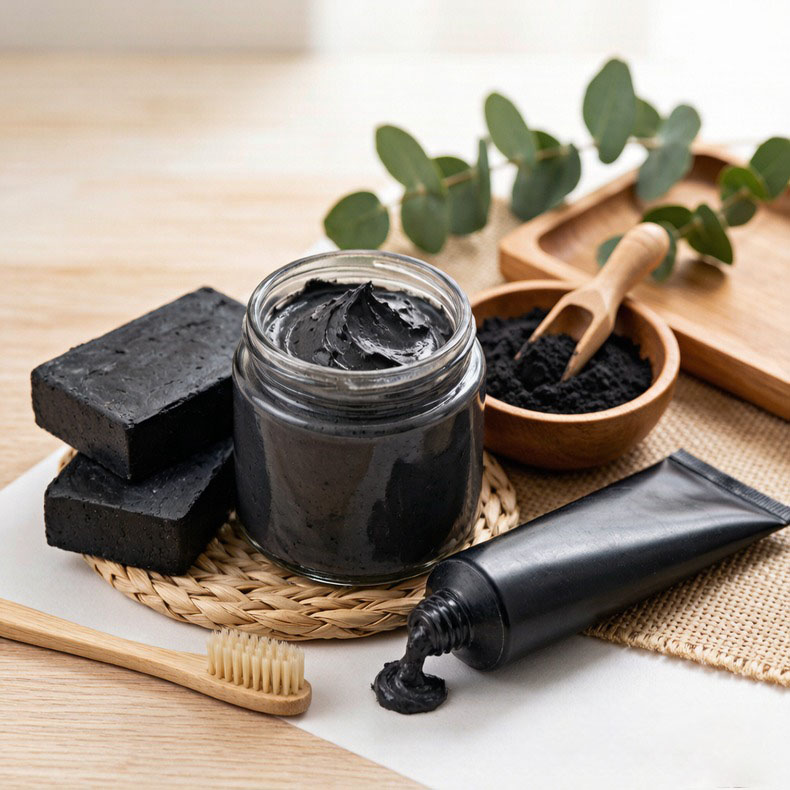
As CI 77266, Vegetable Carbon Black is an approved cosmetic colorant used extensively in natural and organic cosmetic formulations. Its deep black pigment provides intense color payoff while meeting clean beauty standards.
- Eye Makeup: Natural black mascara, eyeliner, eye shadow, brow products
- Skincare: Charcoal face masks, black peel-off masks, charcoal exfoliating scrubs
- Soap Making: Black charcoal soap bars, activated charcoal bath bombs
- Oral Care: Charcoal toothpaste, black tooth powder, charcoal mouthwash
- Hair Care: Black hair dyes (natural), charcoal scalp treatments, black dry shampoo
- Nail Products: Black nail polish (natural pigment base)
- Body Care: Charcoal body washes, black bath salts, detoxifying body wraps
FAQ
Q1: What is Vegetable Carbon Black and how is it made?
Vegetable Carbon Black (E153, CI 77266) is a natural black pigment produced by the controlled carbonization (high-temperature heating in the absence of oxygen) of plant-based materials such as wood, coconut shells, bamboo, and cellulose. The resulting product is a fine, odorless, tasteless black powder composed primarily of elemental carbon. Unlike synthetic carbon black derived from petroleum, our product is exclusively plant-based and suitable for natural and clean-label formulations.
Q2: Is Vegetable Carbon Black safe for food use?
Yes. Vegetable Carbon Black (E153) has been evaluated and approved as a food colorant by major regulatory authorities worldwide, including the European Food Safety Authority (EFSA) in the EU and the Ministry of Health, Labour and Welfare in Japan. In the United States, the FDA lists it as a color additive exempt from certification under 21 CFR 73. It is widely used in ice cream, bakery products, confectionery, beverages, and dairy products.
Q3: What is the difference between Vegetable Carbon Black and regular Activated Charcoal?
While both are forms of carbon produced from plant sources, Vegetable Carbon Black (E153) is specifically manufactured to meet strict food-grade purity specifications for use as a food colorant. Regular activated charcoal may not meet the same purity standards or particle size requirements. Always use food-grade E153-certified Vegetable Carbon Black for food, cosmetic, and pharmaceutical applications.
Q4: Is Vegetable Carbon Black vegan and vegetarian-friendly?
Yes. Vegetable Carbon Black is derived exclusively from plant-based materials (wood, coconut shells, bamboo, cellulose) and contains no animal-derived ingredients. It is suitable for vegan and vegetarian products. Our product is also certified KOSHER and HALAL.
Q5: Can Vegetable Carbon Black be used in organic products?
Regulatory status varies by jurisdiction. In the EU, E153 is permitted in organic food products subject to specific conditions. In the US, activated charcoal is allowed in organic processed products when produced from organic-compliant raw materials. We recommend consulting your local organic certifying body for specific guidance. We can provide documentation to support your organic certification process.
Q6: What is the minimum order quantity (MOQ)?
Our standard MOQ is 25 kg for trial orders. For regular bulk purchases, we offer flexible quantities starting from 100 kg. Sample quantities (100–500 g) are available free of charge for evaluation purposes. Contact our sales team for custom arrangements.