Vanillin CAS:121-33-5 CAS 121-33-5 4-Hydroxy-3-methoxybenzaldehyde FEMA 3107 The World’s Most Popular Flavor Compound
Product Introduction
Vanillin (4-hydroxy-3-methoxybenzaldehyde, CAS 121-33-5) is the primary chemical component responsible for the characteristic flavor and aroma of vanilla. First isolated from vanilla beans in 1858 by Nicolas-Theodore Gobley, vanillin has since become the world’s most widely used flavor compound — an indispensable ingredient across the global food & beverage, fragrance, cosmetics, and pharmaceutical industries.
Product at a Glance
| Parameter | Value |
| Product Name | Vanillin |
| CAS Number | 121-33-5 |
| IUPAC Name | 4-Hydroxy-3-methoxybenzaldehyde |
| Other Names | Vanillaldehyde, Vanillic aldehyde, Methyl protocatechuic aldehyde, FEMA 3107 |
| Molecular Formula | C₈H₈O₃ |
| Molecular Weight | 152.15 g/mol |
| EINECS | 204-465-2 |
| Appearance | White to slightly yellow crystalline powder or needles |
| Odor | Sweet, creamy, characteristic intense vanilla |
| Available Purity | ≥99.0%, ≥99.5%, ≥99.8% (HPLC) |
| Grade Options | Food Grade (FCC) / Pharmaceutical Grade (USP/EP) / Fragrance Grade |
| Product Types | Synthetic (Guaiacol route), Bio-based (Fermentation), Natural (Vanilla bean extract) |
| Shelf Life | 24-36 months (properly stored) |
| Annual Capacity | 2,000+ metric tons |
| MOQ | 1 kg (trial); 25 kg / 500 kg (commercial) |
Applications
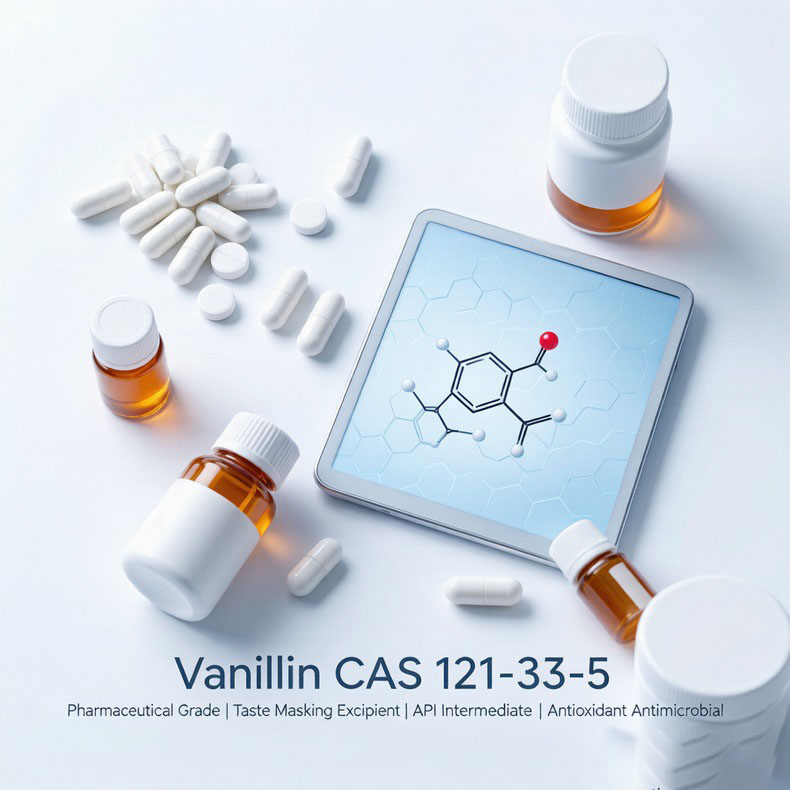
| Application | Product Examples | Typical Usage Level | Function |
| Bakery Products | Cakes, cookies, bread, pastries, muffins, donuts | 0.05–0.2% of flour weight | Vanilla flavor, aroma enhancement, masking off-notes |
| Chocolate & Confectionery | Milk/dark chocolate, hard candies, toffees, caramels, chewing gum | 0.02–0.1% | Flavor rounding, bitterness masking, sweetness enhancement |
| Ice Cream & Frozen Desserts | Ice cream, gelato, frozen yogurt, sorbet, popsicles | 0.01–0.05% | Core vanilla flavor note, creamy mouthfeel synergy |
| Dairy Products | Yogurt, flavored milk, cream, pudding, custard, cheese | 0.005–0.03% | Flavor enhancement, masking dairy off-notes |
| Beverages | Soft drinks, RTD coffee/tea, protein shakes, smoothies, flavored water | 0.001–0.01% | Flavor depth, sweetness enhancement, bitterness reduction |
| Breakfast Cereals & Bars | Granola, protein bars, cereal coatings, oatmeal | 0.02–0.1% | Flavor coating, aroma appeal, product differentiation |
| Sugar Reduction Formulations | Reduced-sugar beverages, low-calorie desserts | 0.05–0.2% | Sweetness perception enhancement, mouthfeel compensation |
FAQ
Q1: What is vanillin and where does it come from?
A: Vanillin (CAS 121-33-5) is the primary chemical compound responsible for the characteristic flavor and aroma of vanilla. It occurs naturally in vanilla beans (Vanilla planifolia) at 1–2% concentration, but over 99% of the world’s commercial vanillin is produced synthetically from guaiacol (petrochemical route) or through bio-fermentation. Natural vanillin accounts for less than 1% of the total vanillin consumed globally due to the extreme scarcity and cost of natural vanilla beans.
Q2: Is your vanillin natural or synthetic?
A: We offer both synthetic vanillin (guaiacol route, ≥99.5% purity) and bio-based vanillin (fermentation-derived, classified as “natural flavoring” under EU and US regulations). Synthetic vanillin provides the most cost-effective solution at ~$12–18/kg, while our bio-based vanillin meets clean-label requirements at ~$500–900/kg. We can advise on which option best suits your product positioning, target market, and budget.
Q3: What is the difference between vanillin and vanilla extract?
A: Vanillin is the single primary flavor compound in vanilla, a pure white crystalline powder. Vanilla extract is a complex mixture extracted from cured vanilla beans containing vanillin (1–2%) plus 200+ other aromatic compounds (vanillic acid, p-hydroxybenzaldehyde, etc.) that contribute to the authentic, multi-dimensional flavor of natural vanilla. Vanillin provides 95%+ of the characteristic vanilla note at a fraction of the cost ($12–18/kg vs $1,200–4,000/kg).
Q4: What purity grades do you offer?
A: Our standard food grade is ≥99.5% (HPLC), suitable for virtually all food and beverage applications. For premium applications, we offer ≥99.8% with enhanced organoleptic purity. For pharmaceutical use (taste masking, API intermediate synthesis), we supply USP/EP-compliant grade with full pharmacopoeia documentation. Please specify your requirements when inquiring.
Q5: How does vanillin compare to ethyl vanillin?
A: Ethyl vanillin (CAS 121-32-4) is approximately 2.5–3 times stronger in flavoring power than vanillin and has a slightly more intense, candy-like vanilla character. It is particularly well-suited to chocolate and confectionery applications. On a cost-per-flavor-unit basis, ethyl vanillin is often more economical despite its slightly higher per-kg price. We supply both compounds and can help you select the best option.
Q6: Is vanillin heat-stable for baking applications?
A: Yes, vanillin is stable up to approximately 120 °C (248 °F) under normal processing conditions. In baking applications (oven temperatures 160–220 °C), expect approximately 15–25% vanillin loss due to volatilization and thermal degradation. We recommend compensating for this loss by adding 20–30% extra vanillin in the formulation. For extreme high-temperature applications, microencapsulated vanillin offers improved heat stability.