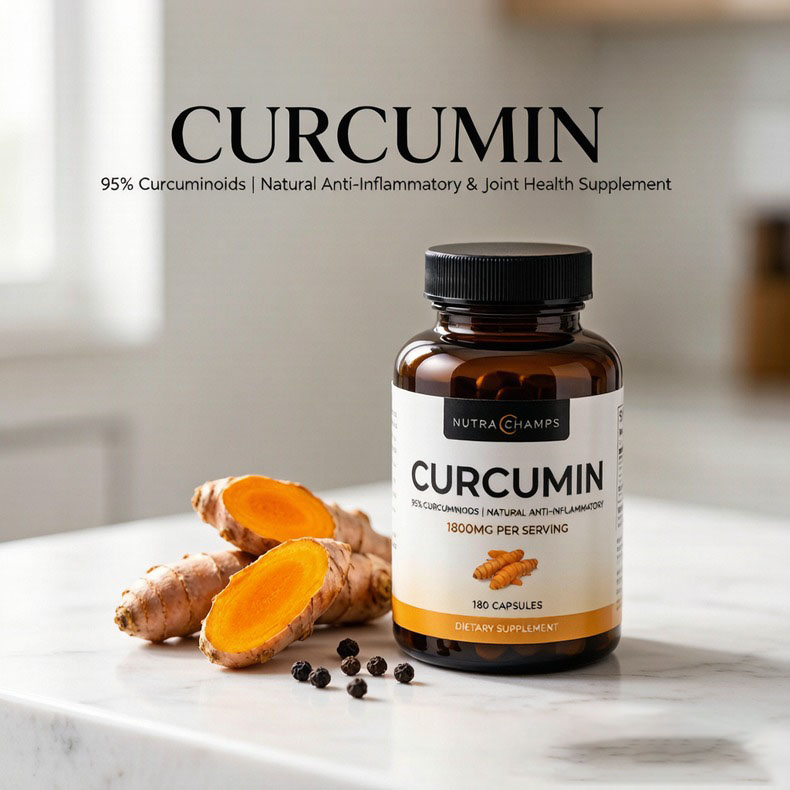
Food Grade Natural Curcumin Fine Orange Yellow Powder Good Stability For Beverage Seasoning Supplement Additive
Product Introduction
Curcumin is the principal bioactive polyphenol derived from the rhizomes of turmeric (Curcuma longa L.), a perennial herb in the Zingiberaceae family. Known for its characteristic vibrant orange-yellow color, curcumin has been used for over 4,000 years in traditional Ayurvedic and Chinese medicine systems for its anti-inflammatory, digestive, and wound-healing properties. In modern science, curcumin is one of the most extensively researched natural compounds, with over 15,000 peer-reviewed publications and more than 300 registered clinical trials (ClinicalTrials.gov) exploring its therapeutic potential.
Product Attribute
| Parameter | Detail |
| Product Name | Curcumin (Turmeric Extract, Curcuminoids) |
| CAS Number | 458-37-7 |
| EC Number | 207-280-5 |
| Molecular Formula | C₂₁H₂₀O₆ |
| Molecular Weight | 368.38 g/mol |
| IUPAC Name | (1E,6E)-1,7-Bis(4-hydroxy-3-methoxyphenyl)hepta-1,6-diene-3,5-dione |
| Botanical Source | Curcuma longa L. — dried rhizomes (Zingiberaceae family) |
| Active Compounds (Curcuminoids) | Curcumin (~77%), Demethoxycurcumin (~17%), Bisdemethoxycurcumin (~3%) |
| Standardized Content | ≥95% Total Curcuminoids (HPLC); Curcumin ≥75% |
| Appearance | Orange-yellow to orange crystalline powder |
| Odor & Taste | Characteristic aromatic, slightly bitter and pungent |
| Melting Point | 183–186°C |
| Solubility | Practically insoluble in water (~11 ng/mL); soluble in ethanol, DMSO, acetone; alkali solutions (red-brown) |
| LogP | ~3.29 (moderate lipophilicity) |
| λmax (UV-Vis) | 425–430 nm (in ethanol) |
| HS Code | 3203.00.10 (Coloring matter of vegetable origin) / 2932.99.90 |
| Food Additive Code | E100 (EU); INS 100(i) (Codex Alimentarius) |
| GRAS Status | Generally Recognized as Safe (U.S. FDA 21 CFR 182.10, GRN 822, 942, 956) |
| Pharmacopoeia | USP-NF (Curcuminoids); EP; JP; FCC; JECFA |
| Daily Intake (ADI) | 0–3 mg/kg body weight (JECFA); 0–4 mg/kg bw (EFSA, 2014) |
Applications
Dietary Supplements & Nutraceuticals
Curcumin is the most popular botanical dietary supplement ingredient globally after multivitamins and omega-3s, with an estimated 15+ million U.S. adults taking turmeric/curcumin supplements regularly (NHIS data). It is formulated as capsules, tablets, softgels, gummies, and effervescent powders as a standalone joint/anti-inflammatory supplement or in combination formulas. Key formulation considerations include bioavailability enhancement (piperine, Meriva® phytosome, BCM-95®, Theracurmin®, Longvida®, NovaSOL®), as native curcumin has oral bioavailability of only 1–2% due to poor aqueous solubility, rapid intestinal/hepatic metabolism (glucuronidation and sulfation), and rapid systemic clearance. Enhanced formulations achieve 6–185× higher relative bioavailability.
Functional Foods & Beverages
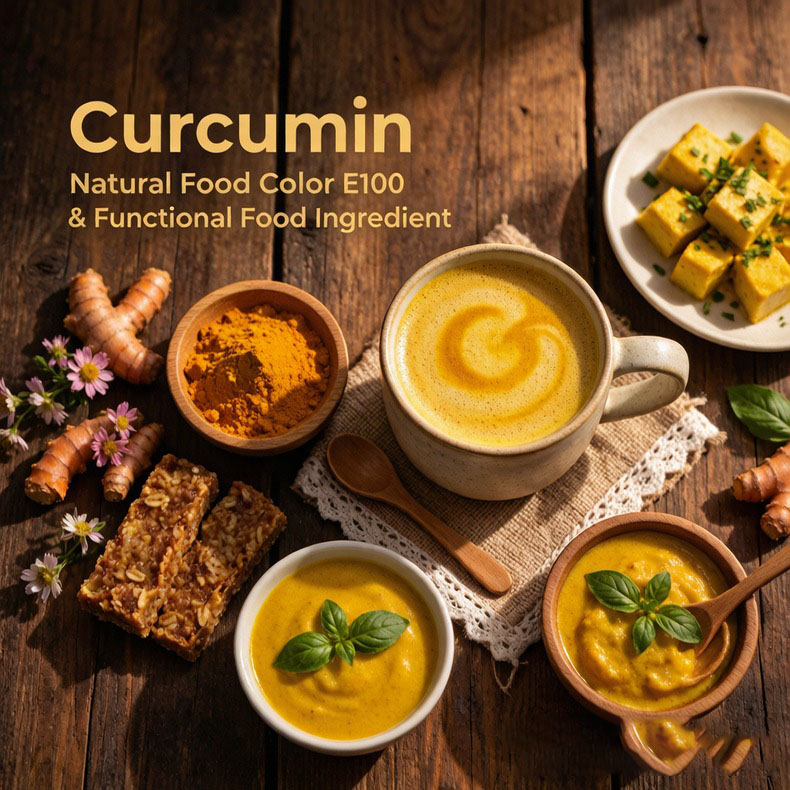
Curcumin is approved as a natural food color additive (E100 in EU, INS 100(i) in Codex Alimentarius) providing yellow-to-orange hues in a wide range of food products including dairy, bakery, confectionery, beverages, sauces, and prepared meals. The clean-label trend has accelerated demand for curcumin as a replacement for synthetic colors (Tartrazine E102, Sunset Yellow E110). Beyond coloring, curcumin is increasingly added at bioactive levels to functional beverages (turmeric lattes, golden milk, wellness shots, kombucha), snack bars, soups, and meal replacements. Our water-dispersible microencapsulated curcumin grades overcome the inherent solubility and staining challenges of native curcumin powder.
Pharmaceutical Intermediates
High-purity curcumin (≥98% HPLC) and individual curcuminoid fractions are supplied as active pharmaceutical ingredient (API) starting materials and reference standards for pharmaceutical development. Curcumin is being investigated as monotherapy and adjunct therapy in clinical trials for osteoarthritis, rheumatoid arthritis, ulcerative colitis, pancreatic cancer (in combination with gemcitabine), multiple myeloma, Alzheimer’s disease, and major depressive disorder (MDD). The FDA has granted Orphan Drug designation to formulations of curcumin for certain rare disease applications.