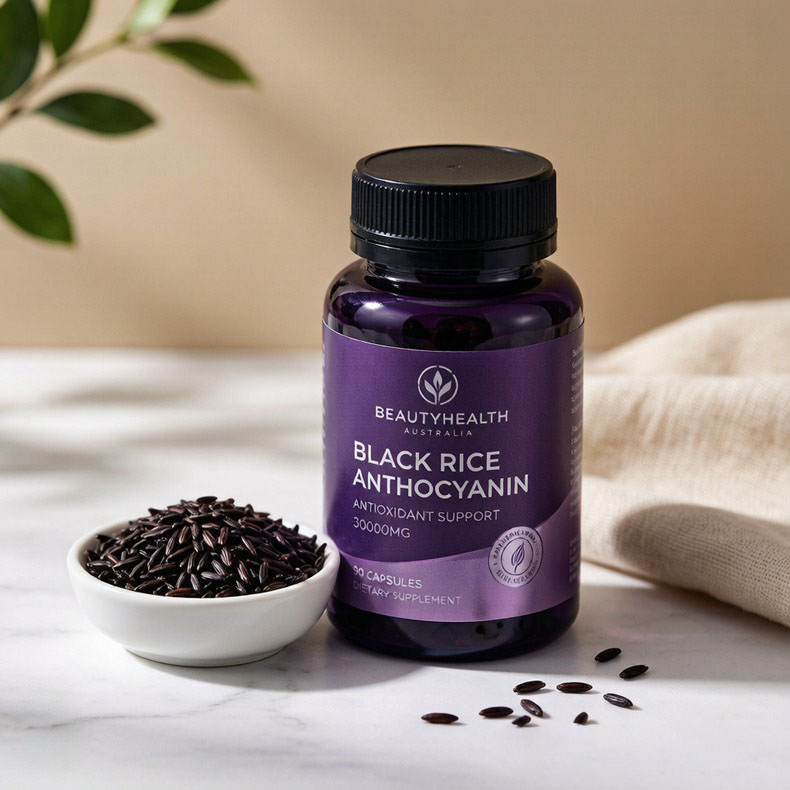
Black Rice Anthocyanin
(Cyanidin-3-Glucoside / Cyanidin Chloride)
CAS 528-58-5
Product Introduction
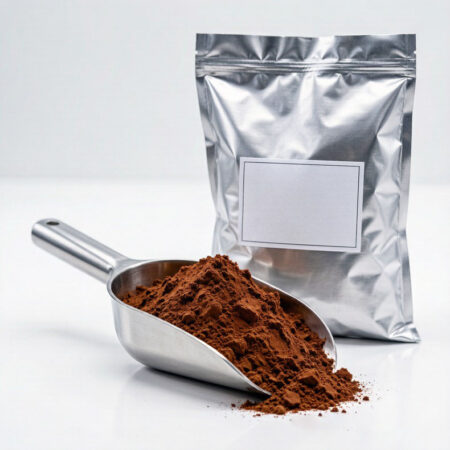
Black Rice Anthocyanin is a premium natural anthocyanin-rich extract derived from the deeply pigmented bran layer of black rice (Oryza sativa L., Poaceae). The product is standardized to contain not less than 25% total anthocyanidins, calculated as Cyanidin Chloride (CAS 528-58-5), the aglycone core of the predominant anthocyanin Cyanidin-3-O-glucoside (C3G, CAS 7084-24-4).
Chemical Properties
| Parameter | Value |
| CAS Registry Number | 528-58-5 |
| IUPAC Name | 2-(3,4-Dihydroxyphenyl)chromenylium-3,5,7-triol chloride |
| Molecular Formula | C₁₅H₁₁ClO₆ |
| Molecular Weight | 322.70 g/mol (chloride); 287.24 g/mol (cation) |
| Chemical Class | Anthocyanidin (Flavonoid) |
| Chromophore | Flavylium cation (red-violet in acidic pH) |
| UV-Vis λmax | ~520 nm (visible); ~280 nm (UV) |
| Appearance (chloride) | Dark red to purple-red crystalline powder |
| Solubility | Soluble in water, methanol, ethanol; pH-dependent color |
| Stability | Stable at pH < 3; degrades at pH > 5; light-sensitive |
Applications
| Health Domain | Mechanism | Clinical/Preclinical Evidence Level |
| Glycemic Control | α-amylase/α-glucosidase inhibition; SGLT1/GLUT2 inhibition; GLUT4 translocation via PI3K/Akt | Level 1: Meta-analysis (17 RCTs); postprandial glucose -30 to -50% |
| Weight & Fat Management | Pancreatic lipase inhibition; AMPK activation; adipocyte differentiation modulation | Level 2: RCT (88 postmenopausal women, 12 w); trunk fat significantly reduced |
| Cardiovascular Protection | NPC1L1 downregulation; CYP7A1 upregulation; eNOS activation (PI3K/Akt); NF-κB suppression | Level 2: Animal model LDL -22%; human FMD +12%; epidemiological diabetes risk -16% |
| Anti-Inflammatory Activity | NF-κB p65 nuclear translocation inhibition; NLRP3 inflammasome suppression; MAPK modulation | Level 2: Cell + animal models; IL-1β/IL-18 suppression confirmed |
| Antioxidant Defense | Nrf2/HO-1 upregulation; direct radical scavenging; metal chelation; SOD/catalase induction | Level 1: Acute human trials show plasma antioxidant capacity increase |
| Cognitive & Neuroprotection | AChE and MAO inhibition; Nrf2/HO-1-mediated oxidative stress reduction; Aβ aggregation inhibition | Level 2: RCT (8 w, 1g/d germinated extract); improved working memory and attention |
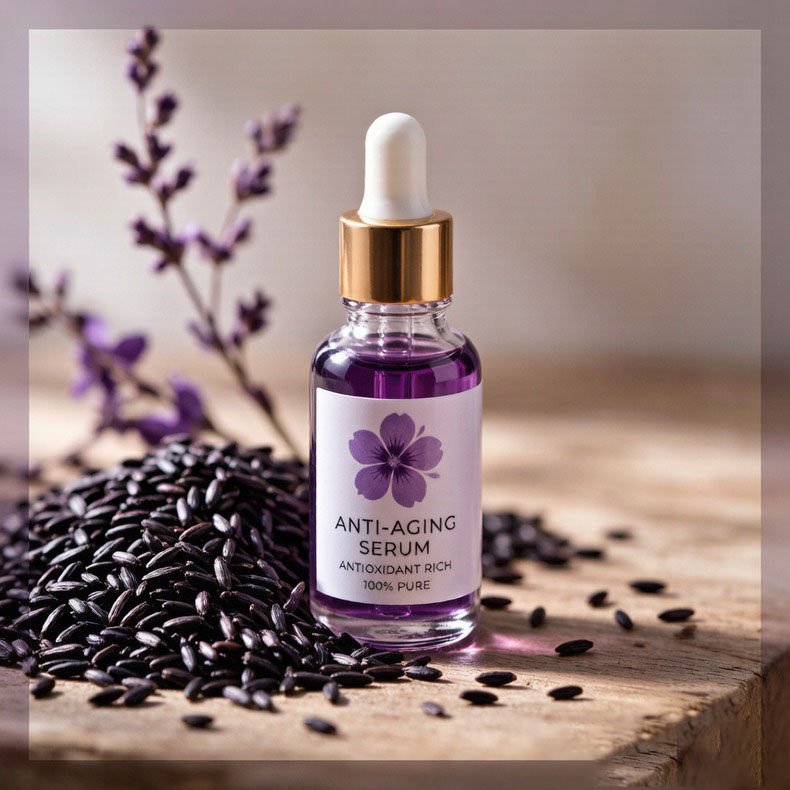
| Skin Health & Anti-Aging | Tyrosinase inhibition (whitening); MMP suppression (anti-wrinkle); UV protection; collagen preservation | Level 3: In vitro data; growing cosmeceutical application |
| Anti-Cancer Potential | MMP-9/u-PA suppression; AP-1 inhibition; cell cycle arrest; apoptosis induction | Level 3: In vitro (SKHep-1, Huh-7, HeLa, SCC-4); in vivo (aflatoxin B1 HCC rat model) |
| Renal Protection | NDRG2 upregulation via PI3K/AKT; EMT and ECM inhibition in UUO model | Level 3: Animal model (UUO rat, 2025 Nature Scientific Reports) |
FAQ
Q1: What is the difference between Cyanidin (CAS 528-58-5) and Cyanidin-3-Glucoside (CAS 7084-24-4)?
Cyanidin (CAS 528-58-5) is the aglycone (sugar-free) anthocyanidin core. Cyanidin-3-O-glucoside (C3G, CAS 7084-24-4) is the glycoside form — cyanidin attached to a glucose molecule at the 3-position. C3G is the naturally occurring form in black rice (~88% of total anthocyanins). The aglycone CAS number (528-58-5) is used as the quantification reference standard because all anthocyanins are hydrolyzed to their aglycone forms and measured as “total anthocyanidins, calculated as Cyanidin.”
Q2: Why is black rice anthocyanin superior to bilberry or blueberry anthocyanins?
Black rice bran contains significantly higher anthocyanin concentrations (850+ mg/kg vs. ~500 mg/kg for blueberries). More importantly, black rice anthocyanins are predominantly cyanidin-3-glucoside (C3G, ~88%), the single most extensively studied dietary anthocyanin with well-characterized pharmacokinetics and 17+ RCTs. Mixed-source anthocyanin extracts (e.g., bilberry) contain diverse anthocyanin profiles, making standardized pharmacological characterization more challenging.
Q3: Is black rice anthocyanin stable during food processing?
Anthocyanin stability is strongly pH-dependent. It is excellent at pH < 3 (acidic beverages), moderate at neutral pH, and poor under alkaline conditions. Heat processing (baking at > 160 °C) results in 40–60% degradation; microencapsulation is recommended for baked goods. For best color retention, maintain pH < 4, use ascorbic acid as a co-pigment, and protect from direct light exposure.
Q4: Can black rice anthocyanin be used as the sole natural purple colorant?
Yes. Black rice anthocyanin (E163) provides vibrant red-to-purple hues depending on pH and is approved as a food colorant in the EU (E163), USA (exempt from certification), and most global markets. Unlike grape skin extract, black rice anthocyanin has a simpler anthocyanin profile (primarily C3G), resulting in more predictable and consistent color performance. It is water-soluble and compatible with clear beverages at pH < 3.5.
Q5: What is the recommended daily dose of black rice anthocyanin for metabolic health?
Clinical trials have used doses ranging from 300 mg/day to 1,000 mg/day of black rice extract (standardized to 25% anthocyanins = 75–250 mg anthocyanins/day). For glycemic control, 500 mg/day microencapsulated anthocyanin has demonstrated significant postprandial glucose reduction. For general antioxidant support, 100–200 mg anthocyanins/day is typical. Always formulate per regional supplement regulations.
Q6: Is black rice anthocyanin non-GMO, gluten-free, and allergen-free?
Yes. Our black rice anthocyanin is derived from non-GMO black rice bran, is naturally gluten-free, and contains no major food allergens (milk, eggs, fish, shellfish, tree nuts, peanuts, wheat, soy). It is suitable for vegan, vegetarian, clean-label, and free-from product formulations. Separate allergen and GMO statements are available with each shipment.