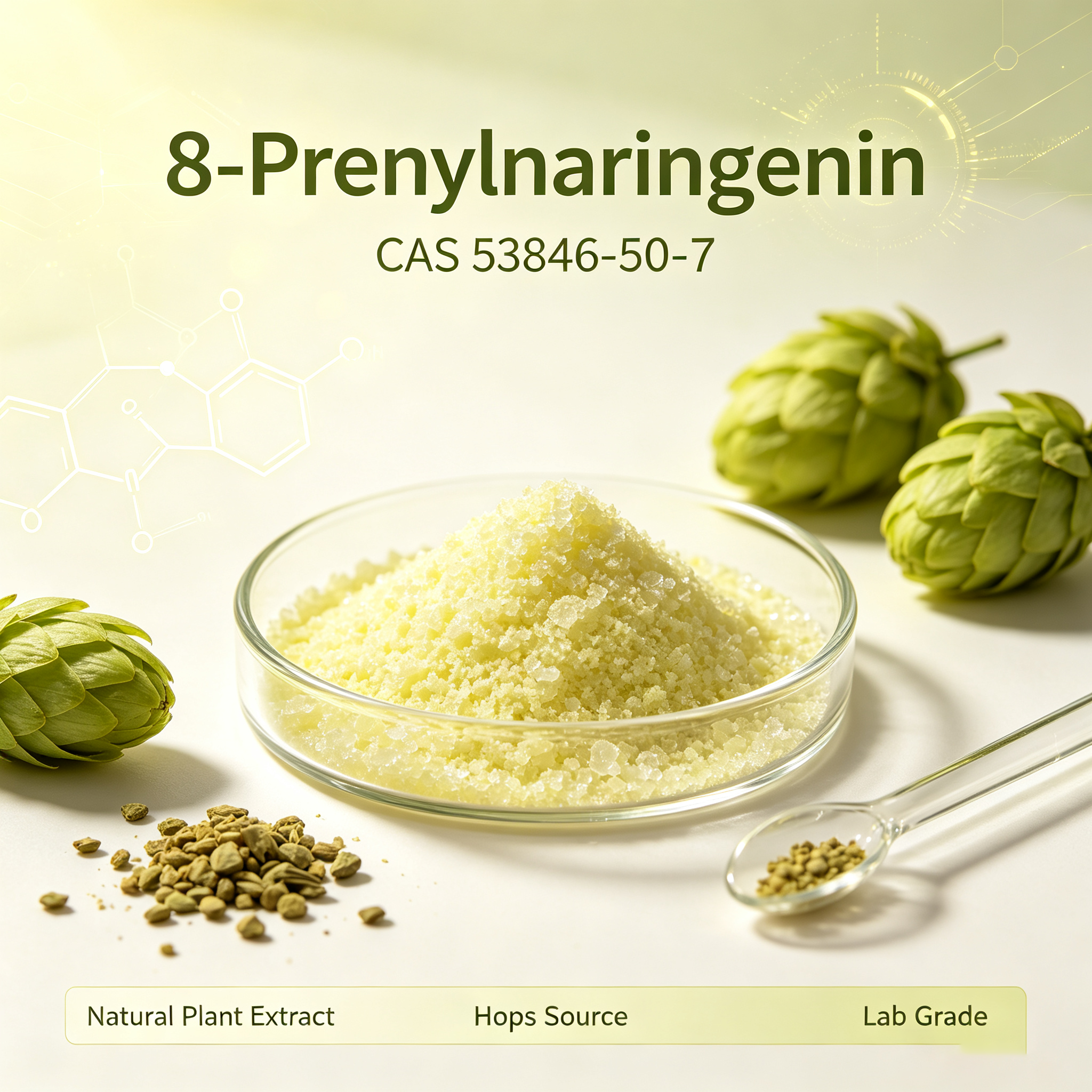
8-Prenylnaringenin CAS:53846-50-7
Product Specifications
| Item | Detail |
|---|---|
| Synonyms | 8-Prenylnaringenin; 8-PN; 5,7-Dihydroxy-2-(4-hydroxyphenyl)-6-(3-methylbut-2-en-1-yl)-2,3-dihydrochromen-4-one (prenylated flavanone, naringenin C8-prenyl) |
| CAS RN | 53846-50-7 |
| Upstream CAS (cascade) | Xanthohumol 6754-58-1 (chalcone) → Isoxanthohumol 70872-29-6 (flavanone) → 8-PN 53846-50-7 (flavanone-desmethyl) |
| Molecular Formula | C₂₀H₂₀O₅ |
| MW | 340.38 |
| Botanical (cascade origin) | Humulus lupulusL., Cannabaceae |
| HS Code (ref) | 2938 / 2908 (phenol derivative) |
| R&D Cluster | "Hops polyphenol cascade" trio — Taima cross-links all three SKUs |
Product Description
8-Prenylnaringenin CAS 53846-50-7 Prenylated Flavanone from Humulus lupulus Cascade
Product Identification
Description
8-PN is the terminal, most bioactive node of the Hops prenyl-cascade — and the strongest plant-derived phytoestrogen reported (ERα relative binding ~30–50% of 17β-estradiol in competitive binding lit; ERα-selective over ERβ, partial agonist profile). The cascade logic:
Humulusraw hops (Xn, chalcone) → wort boil / acid (Iso, flavanone) → oral ingestion → gut microbiota O-demethylation (Iso → 8-PN, flavanone-desmethyl). 8-PN is thus both a molecule and a PK endpoint — most Hops "menopausal hot-flush" human lit (small N, DE/NL studies) measures urine/plasma 8-PN after Hops supplement, not Xn/Iso directly.
Three commercial angles (all B2B R&D, no DTC):
- PK / Gut Metabolism R&D (B2B main): Pure 8-PN ≥98% as cascade probe standard — (a) oral Xn → plasma Iso AUC vs. Xn AUC vs. 8-PN AUC in animal/model; (b) gut microbiota strain screening (which strains demethyl Iso→8PN efficiently — inter-individual variation lit, relevance to "Hops responder/non-responder" in human); (c) formulation studies (protect Xn from premature conversion vs. drive Iso→8PN). Inner-link to Taima's Xn 6754-58-1 + Iso 70872-29-6 — "Hops cascade R&D trio" procurement: one PO covers Xn-feedstock (98%) + Iso (98%) + 8-PN (98%) + research-grade Hops P.E. triple-peak.
- Endocrine / SERM / Menopausal R&D (R&D-only, compliance hard): 8-PN ERα partial agonist lit — bone (anti-resorptive in OVX models), vasomotor (hot-flush mechanistic), breast (paradox — ERα agonist in breast tissue, but some lit shows isoform-selective / SERM-like — controversial, pharma R&D interest). DTC cannot touch "menopause / HRT / breast / estrogen" — FDA/EMA phytoestrogen red zone. Taima 8-PN page = R&D procurement only; pharma / CRO / university. Search: "8-prenylnaringenin ER-alpha", "8-PN SERM", "hops menopausal R&D"
- Research-grade Hops P.E. Triple-peak: Xn + Iso + 8PN HPLC (8PN << Iso << Xn in most extracts; dedicated enrichment possible but rare). Brewing/nutra R&D benchmarking "full cascade profile" of a hop cultivar (e.g. Hallertau vs. Cascade vs. Saaz — Xn/Iso/8PN ratios differ slightly by cultivar + process). Taima can quote cultivar-specific research-grade P.E. if in scope.
Applications
PK / Gut Metabolism R&D – 8-PN ≥98% as cascade probe (Xn→Iso→8PN oral PK, gut microbiota O-demethyl screening, "Hops responder" inter-individual variation); inner-link Xn 6754-58-1 + Iso 70872-29-6 "Hops cascade trio"
Endocrine / SERM / ERα R&D – 8-PN ERα partial agonist (strongest plant phytoestrogen), OVX-bone / hot-flush mechanistic, SERM-adjacent pharma interest; R&D-only, no DTC copy (FDA/EMA phytoestrogen boundary — Xn/Iso pages carry DTC soft, 8-PN page does NOT)
Research-grade Hops P.E. Triple-peak – Xn+Iso+8PN HPLC (8PN trace unless enriched), cultivar-specific benchmarking (Hallertau/Cascade/Saaz), brewing/nutra R&D "full cascade" profile
Reference Standard (≥98%) – for Hops P.E. triple-peak QC, cascade PK assays, SERM/endocrine R&D, formulation pilot (semi-synthetic cascade from Xn-feedstock)
Request a Quote or Free Sample
Xi'an Taima supplies this product worldwide with full COA, MSDS, and technical documentation. Contact our team for pricing and sample requests.
Contact Our Team →