Premium Hydroxyecdysone CAS 5289-74-7 Anabolic Plant Extract Reduce Recovery Time For Bodybuilding Nutrition

Product Introduction
Hydroxyecdysone (CAS 5289-74-7), also widely known as Ecdysterone, beta-Ecdysterone, or 20-Hydroxyecdysone (20E), is a naturally occurring phytoecdysteroid – a plant-derived steroid compound that has emerged as one of the most scientifically validated natural anabolic agents available to the sports nutrition and nutraceutical industry.
Chemical Parameters
| Parameter | Specification |
| Chemical Name | 20-Hydroxyecdysone; 2beta,3beta,14alpha,20R,22R,25-hexahydroxy-5beta-cholest-7-en-6-one |
| CAS Number | 5289-74-7 |
| Molecular Formula | C27H44O7 |
| Molecular Weight | 480.64 g/mol |
| IUPAC Name | (2S,3R,5R,9R,10R,13R,14S,17S)-2,3,14-trihydroxy-10,13-dimethyl-17-[(2R,3R)-2,3,6-trihydroxy-6-methylheptan-2-yl]-2,3,4,5,9,11,12,15,16,17-decahydro-1H-cyclopenta[a]phenanthren-6-one |
| Synonyms | Ecdysterone, beta-Ecdysterone, Crustecdysone, Isoinokosterone, Viticosterone, Sarconeos (BIO101) |
| Appearance | White to off-white crystalline powder |
| Melting Point | 237.5 – 244 C |
| Solubility – Alcohol/Methanol | Soluble |
| Solubility – Water | Practically insoluble (<0.01%) |
| LogP | ~0.5 (moderately polar) |
| Purity (HPLC) | >=95% / >=98% / >=99% |
| Stereo Centers | 10 chiral centers |
Application
| Health Domain | Proposed Benefit | Mechanism | Evidence Level |
| Glucose Metabolism/Diabetes | Blood glucose regulation, insulin sensitization | AMPK activation improves glucose uptake; hepatic gluconeogenesis modulation | Moderate (animal + early human) |
| Lipid Metabolism/Fat Loss | Enhanced fatty acid oxidation, reduced adipogenesis | AMPK/ACC pathway; PPAR-alpha modulation | Moderate (preclinical strong) |
| Neuroprotection/Cognitive | Memory enhancement, neuroprotective against excitotoxicity | Antioxidant properties; cholinergic modulation; cerebral blood flow improvement | Emerging (animal models promising) |
| Liver Protection (Hepatoprotective) | Protection against chemical-induced liver damage | Antioxidant enzyme induction; anti-inflammatory (NF-kB inhibition); membrane stabilization | Strong (multiple animal studies) |
| Cardiovascular Health | Vascular protection, improved endothelial function | Antioxidant; NO bioavailability enhancement; mild hypolipidemic effect | Moderate (animal + limited human) |
| Bone Health | Osteogenic stimulation, potential osteoporosis support | May enhance osteoblast differentiation via MAPK pathway | Early stage (cell culture data) |
| Immune Modulation | Enhanced immune response, anti-inflammatory | Macrophage activation modulation; cytokine balance restoration | Moderate (immunological studies) |
| Wound Healing | Accelerated tissue repair | Enhanced protein synthesis extends to connective tissue; angiogenesis support | Limited (dermatological applications) |
| Anti-Fatigue/Adaptogen | Reduced exercise fatigue, improved recovery | Enhanced ATP production; glycogen sparing; cortisol modulation | Strong (traditional use + modern validation) |
| Skin Health | Dermatological applications (collagen, wound healing) | Topical formulations under investigation | Emerging (cosmetic R&D) |
FAQ
Q: Is Hydroxyecdysone a steroid? Will it show up on a drug test?
A: Chemically, yes – it IS a steroid molecule (specifically, a phytoecdysteroid – a PLANT-DERIVED steroid). However, it is NOT an anabolic-androgenic steroid (AAS). It does NOT bind the androgen receptor and works through completely different mechanisms. As of 2025, it is NOT on WADA’s Prohibited List – it appears only on the Monitoring Program. Standard employment/drug tests do NOT screen for ecdysterone. However, competitive athletes should always check their sport’s specific federation rules before using any supplement.
Q: How long until I see results?
A: Based on the landmark 10-week Isenmann study, measurable improvements in muscle mass and strength were detectable within the study period. Most users report noticeable effects (improved recovery, slight fullness) within 2-4 weeks, with more significant body composition changes appearing at 6-12 weeks of consistent use combined with proper resistance training and adequate protein intake.
Q: Can women safely take Hydroxyecdysone?
A: YES. Because Hydroxyecdysone does NOT bind androgen receptors, it produces NONE of the masculinizing side effects (deepened voice, facial hair, clitoral enlargement) associated with anabolic steroids. It has been used by female athletes in natural federations without reports of virilization. However, due to its documented estrogen receptor (ER) binding activity, women with estrogen-sensitive conditions should consult a healthcare provider.
Q: Do I need a PCT (Post Cycle Therapy) after using Hydroxyecdysone?
A: NO. PCT is required after anabolic steroid cycles because synthetic steroids suppress your body’s natural testosterone production (HPTA axis suppression). Hydroxyecdysone does NOT suppress natural hormone production – endogenous testosterone, LH, and FSH levels remain completely unaffected. No “cycle support” or post-cycle recovery protocol is needed.
Q: What is the difference between 95%, 98%, and 99% purity grades?
A: All three grades contain Hydroxyecdysone as the primary active component. Higher purity means fewer inactive plant-derived co-compounds (other ecdysteroids, flavonoids, sugars). 95% is cost-effective for standard sports nutrition products. 98% is preferred for premium formulations where consistency matters. 99% (ultra-high-purity) is specified for pharmaceutical applications, clinical research materials, and customers requiring the absolute highest specification.
Q: Is Hydroxyecdysone the same thing as “Russian Secret” or “bug juice”?
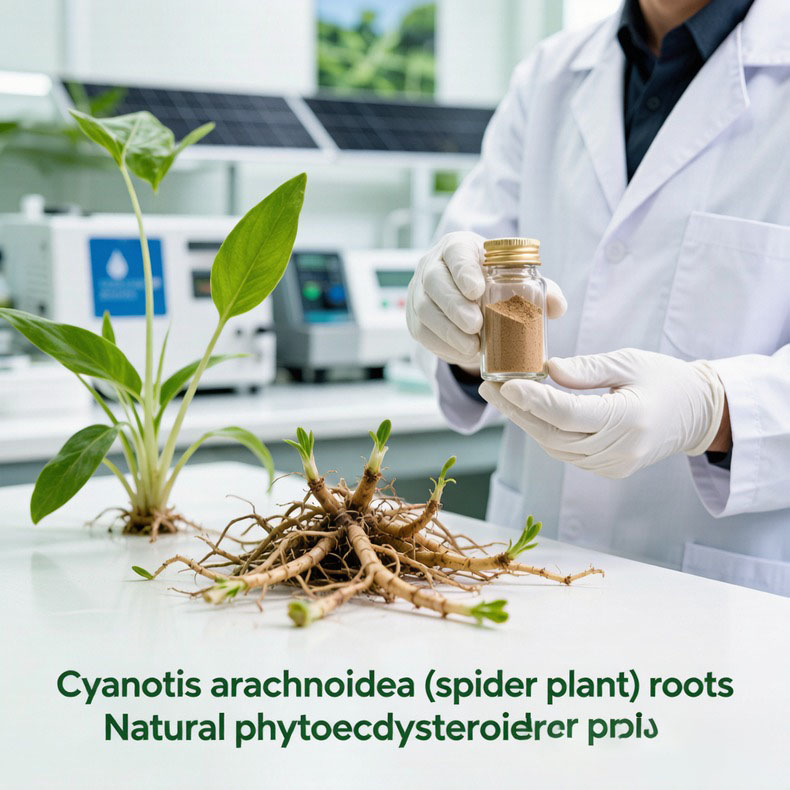
A: “Russian Secret” is a colloquial term dating back to the 1980s when Soviet Olympic athletes were suspected of using ecdysterone-containing preparations (reportedly extracted from Russian Leuzea carthamoides/Maral root). “Bug juice” refers to the fact that ecdysteroids were originally discovered as insect molting hormones – they trigger metamorphosis in insects/arthropods. These nicknames reflect the compound’s history rather than its current pharmaceutical-grade manufacturing process from plant sources like Cyanotis arachnoidea.